SDFA

Since

1977

Where storytellers are learning
School of Drama and Fine Arts
The School of Drama & Fine Arts, established by the University of Calicut in 1977, now stands at the threshold of its Golden Jubilee, marking five decades of theatre education, artistic practice, research, and cultural engagement. From its pioneering beginnings in formal theatre training to its present national and international engagements, the School has evolved into a significant centre for theatre and performing arts education in India.

In the annals of Kerala’s theatrical history, the Nataka Kalari movement emerged as a pioneering initiative that envisioned a new approach to theatre education, one that sought to institutionalise theatre training within a structured academic environment. Guided by the visionary leadership of Professor G. Sankara Pillai and subsequently by Dr. Vayala Vasudevan Pillai, the establishment of the School of Drama marked a transformative moment in the development of formal theatre education in Kerala.

Established in 1977, the School of Drama, under the University of Calicut, has grown into one of India’s significant institutions for higher education and professional training in theatre and the performing arts. The School has consistently sought to integrate the practical, theoretical, creative, and technical dimensions of theatre within its academic framework.

Over the years, the academic programmes of the School have evolved in response to changing approaches to theatre education and the expanding field of performance studies. The three-year Bachelor of Theatre Arts (B.T.A.) programme, which served as an important foundation for undergraduate theatre education at the School, was replaced in 2023 by a five-year Integrated Master of Theatre Arts (Integrated M.T.A.) programme. The integrated programme provides students with a sustained and comprehensive course of study, combining undergraduate and postgraduate-level theatre education within a five-year academic structure. The School also offers the Master of Arts (M.A.) in Music and Ph.D. programmes in Theatre and Drama, along with diploma-level programmes such as Music Therapy and Mridangam.

The curriculum of the School provides students with opportunities to engage with the history, theory, practice, and diverse traditions of theatre. It encompasses creative and technical areas including playwriting, acting, directing, scenography, design, theatre technology, and production. In music education, the curriculum is grounded in Karnatic music, encompassing vocal performance, musical composition, and related areas of study.

A distinctive feature of the School’s pedagogical approach is its engagement with both classical and folk traditions alongside contemporary developments in Indian and global theatre. Theatre is understood not as an isolated artistic discipline but as a form that continually interacts with and incorporates other forms of knowledge and artistic practice. Accordingly, the curriculum extends into allied areas such as yoga, martial arts, cinema, television, media, and other contemporary performance practices.

The School also places considerable emphasis on experiential and practice-oriented learning. Eminent practitioners, scholars, artists, and specialists from India and abroad are regularly invited to conduct lectures, demonstrations, workshops, and practical sessions. These interactions provide students with opportunities to encounter diverse artistic methodologies and perspectives beyond the conventional classroom environment.

The academic community of the School actively engages in theatre productions, short films, workshops, seminars, and other creative initiatives. Faculty members, guest directors, and students collaborate in developing productions that provide practical experience in performance, direction, design, technical production, and interdisciplinary artistic practice. The School has also undertaken placement initiatives and academic collaborations with institutions in India and abroad, creating opportunities for students to engage with wider professional and educational networks.

The curriculum has continued to respond to the expanding field of theatre and performance studies. At the postgraduate level, areas such as Performance Studies, Theatre Therapy, Media Studies, Communication Studies, Folklore, and Post-Media Studies have been incorporated into the academic framework. In the field of music, the School has also developed training and academic initiatives in Music Therapy, reflecting its broader commitment to interdisciplinary and socially engaged approaches to the performing arts.

The establishment of the Music Department in 2000 marked another important phase in the institutional development of the School. The department began offering postgraduate education in Music and subsequently developed doctoral-level research programmes. In the same year, the University of Calicut introduced the Master of Theatre Arts (M.T.A.) programme, strengthening the School’s postgraduate theatre education and expanding opportunities for advanced study in theatre history, theory, performance, playwriting, acting, directing, design, and theatre technology.

The School has maintained a strong commitment to preserving and transmitting Kerala’s classical and folk artistic traditions while simultaneously engaging with contemporary developments in world theatre. Its educational philosophy recognises theatre as an inherently interdisciplinary and evolving art form, capable of assimilating and transforming influences from diverse artistic and intellectual fields.

International and intercultural exchange has also formed an important part of the School’s institutional journey. The School has represented India at various national and international theatre festivals and cultural events. A notable example was its tour to Japan in February 2001, where the School presented Saketham, a theatrical work based on the Ramayana, in Tokyo and Fukuoka. The School also participated in an academic and artistic Exchange Programme with St. Martin’s College, London, during the academic year 2005–2006. Such initiatives have contributed to the School’s engagement with international theatre education and performance practices.

The School’s alumni have made significant contributions to theatre, cinema, music, television, mass media, academia, and cultural institutions in India and abroad. Their diverse professional trajectories reflect the broad range of opportunities and artistic practices that theatre education can facilitate.

Today, the School of Drama continues to evolve in response to the changing landscape of theatre, performance, technology, and arts education. While remaining rooted in the rich classical and folk traditions of Kerala and India, it engages with contemporary performance practices, emerging media, interdisciplinary approaches, and new pedagogies. Through its integrated academic programmes, research, productions, workshops, collaborations, and international engagements, the School remains committed to nurturing creative practitioners, researchers, educators, and cultural professionals.

The School of Drama, Kerala, thus continues its long-standing commitment to theatre and performing arts education—connecting heritage with contemporary practice, disciplinary knowledge with interdisciplinary exploration, and academic learning with creative experience.

Since its establishment in 1977, the School of Drama & Fine Arts (SDFA), University of Calicut, has developed an academic environment in which theatre education is understood as a combination of creative practice, theoretical inquiry, technical training, and research. The School’s pedagogy places strong emphasis on experiential learning, production, workshops, internships, and engagement with practitioners from India and abroad.

Today, SDFA offers a range of programmes that address different stages of academic and professional development in theatre, music, and research. The present academic structure includes the Five-Year Integrated Master of Theatre Arts, Two-Year Master of Theatre Arts, Two-Year Master of Arts in Music, and Ph.D. in Theatre and Drama.

1. Five-Year Integrated Master of Theatre Arts (Integrated M.T.A.)

Introduced in 2023 in place of the earlier three-year B.T.A. programme, the Integrated M.T.A. provides an extended and comprehensive pathway for theatre education. It integrates practical training with theoretical study in acting, direction, playwriting, theatre technology, visual design, performance studies, film and media, and related disciplines. The curriculum includes production work, internships, creative writing, projection design, community theatre, theatre management, sound, lighting, costume, makeup, and filmmaking, enabling students to engage with multiple dimensions of contemporary theatre practice.

2. Master of Theatre Arts (M.T.A.)

The two-year M.T.A. is a postgraduate programme designed around advanced practical and research-oriented theatre education. It engages students with acting, direction, stagecraft, play production, children’s theatre, theatre technology, research methodology, seminars, workshops, film and audio-visual practices, mass communication, and folklore. The programme seeks to develop practitioners who can engage professionally with theatre while also developing capacities for teaching, research, and academic practice.

3. Master of Arts in Music (M.A. Music)

The two-year M.A. Music programme provides advanced study and performance training with a strong foundation in Karnatic music. Its curriculum encompasses music history, theory, musical compositions, Varnams and Keerthanams, Manodharma Sangita, Ragam-Tanam-Pallavi, performance, and musicological study. The programme combines practical performance with academic inquiry, culminating in project/dissertation work and a music concert.

4. Ph.D. in Theatre and Drama

The doctoral programme provides a framework for advanced research in theatre and drama. Scholars undertake specialised research under the guidance of recognised research supervisors, supported by the School’s wider academic environment of productions, conferences, seminars, workshops, and interactions with practitioners and scholars. The programme has a minimum duration of three years and a maximum duration of five years.

Towards the Future

The academic vision of SDFA extends beyond conventional theatre training towards an international school of theatre where new perspectives meet indigenous forms of knowledge and practice. As theatre increasingly intersects with digital media, emerging technologies, new forms of performance, interdisciplinary research, and changing modes of cultural production, the School’s academic programmes provide a foundation for students to innovate, experiment, research, and respond to the evolving landscape of theatre, film, visual media, and performance.

Its continuing engagement with international practitioners, academic exchanges, festivals, and contemporary theatre discourse further positions the School as a space where Kerala’s artistic traditions can encounter emerging global practices.

In this continuing journey, SDFA looks towards a future in which theatre education is not confined to the stage, but expands into new technologies, new media, interdisciplinary knowledge, community engagement, and emerging forms of performance—preparing the next generation of artists, educators, researchers, and cultural practitioners for an increasingly connected world.

The School of Drama & Fine Arts (SDFA), University of Calicut, extends its academic and artistic activities beyond its regular degree programmes through a range of extension initiatives. These programmes create opportunities for students, practitioners, children, communities, and academic institutions to engage with theatre as a medium of learning, collaboration, cultural exchange, and social engagement.

Major Academic Extension Programmes

  • Calicut University Little Theatre (CULT)
  • Child Art and Recreation Theatre (CART)
  • International Festival of Theatre Schools (IFTS)
  • International Theatre Conference (ITC)
  • Social Outreach Programmes

Calicut University Little Theatre (CULT)

Calicut University Little Theatre (CULT) functions as the repertory of the department, providing students and alumni with opportunities to participate in theatre productions from conception to performance and touring.

Child Art and Recreation Theatre (CART)

Child Art and Recreation Theatre (CART) is an interdisciplinary initiative centred on children, education, and creative development. It enables students to work directly with children and explore theatre as a tool for learning, personal development, and artistic expression.

International Festival of Theatre Schools (IFTS)

The International Festival of Theatre Schools (IFTS) brings together theatre academicians and practitioners from India and abroad to create a platform for dialogue between theatre education and professional practice. The festival provides an international environment for sharing pedagogical approaches, experiences, and emerging perspectives in theatre education.

International Theatre Conference (ITC)

The International Theatre Conference (ITC) provides an academic forum for students, scholars, academicians, and practitioners to discuss contemporary theatre, performing arts, technology, and related social and cultural questions.

Social Outreach Programmes

The School also undertakes collaborative social outreach initiatives with governmental and non-governmental organisations. These programmes extend theatre education beyond the campus and encourage students to engage with communities and social concerns through interdisciplinary theatre practices.

Through these extension programmes, SDFA creates a continuum between classroom learning, artistic practice, community engagement, and international exchange, allowing the School to function not only as an academic institution but also as an active cultural and intellectual space. Its extension activities continue to expand the possibilities of theatre education through collaboration, experimentation, interdisciplinary practice, and engagement with wider society.

Facilities
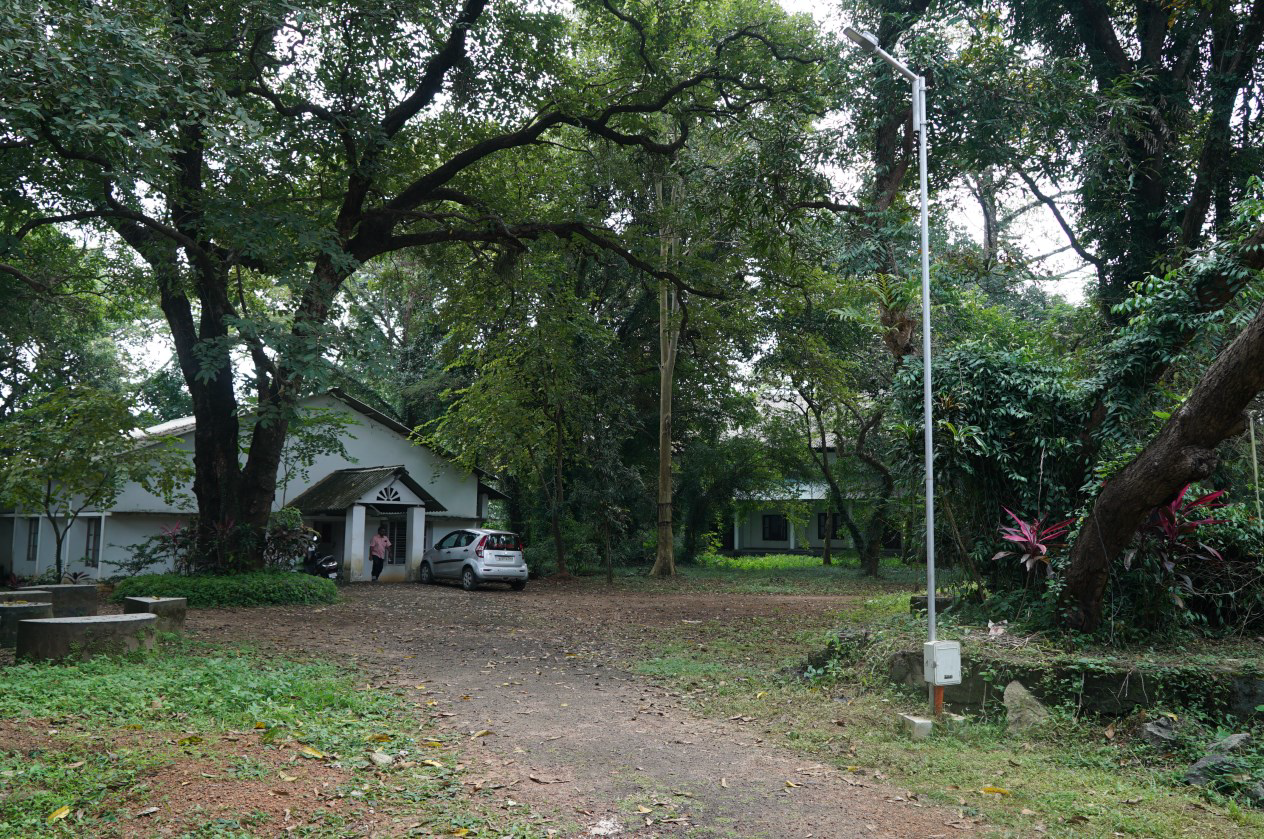
The School of Drama, nestled within a charming campus adorned with lush greenery, offers a comprehensive array of facilities to support its academic and artistic endeavors. Our well-stocked libraries provide a rich resource for research and study, complemented by campus-wide WiFi connectivity for access to online materials. State-of-the-art design studios for makeup and costume creation, modern classrooms, and dedicated student laboratories ensure a conducive learning environment. On the performance front, our theater and auditorium feature professional-grade equipment for realistic stage experiences. For residential students, comfortable hostels and convenient guest houses are available, while a vibrant café caters to culinary needs. These facilities, set in a serene and inspiring location, foster an environment where creativity flourishes, making the School of Drama a haven for aspiring dramatic talents.
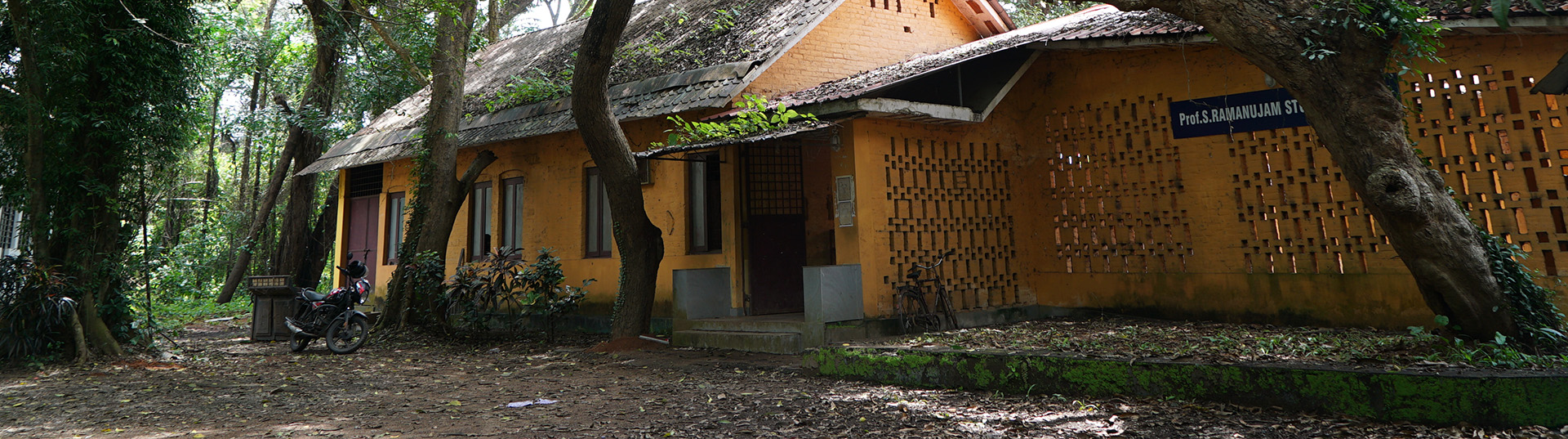
SDFA - Ramanujam Studio
Studio Theatre
PROF. S. RAMANUJAM STUDIO THEATRE
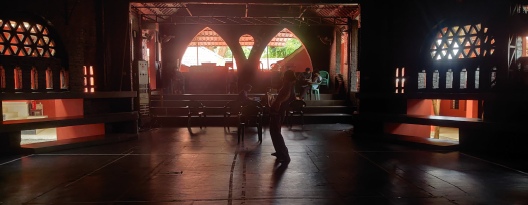
The studio is a distinctive example of architectural excellence, both in its design and construction. The theatre, masterfully designed by the renowned architect Laurie Baker*, distinguishes itself by seamlessly blending with indigenous architectural elements. Its aesthetic beauty is further accentuated by its harmony with the natural ecology of the campus environment. The studio theatre encompasses not only a performance space but also dedicated makeup and costume studios.
Lawrence Wilfred "Laurie" Baker (2 March 1917 – 1 April 2007) was a British-born Indian architect, renowned for his initiatives in cost-effective energy-efficient architecture and designs that maximized space, ventilation and light and maintained an uncluttered yet striking aesthetic sensibility. Influenced by Mahatma Gandhi and his own experiences in the remote Himalayas, he promoted the revival of regional building practices and use of local materials; and combined this with a design philosophy that emphasized a responsible and prudent use of resources and energy. He was a pioneer of sustainable architecture as well as organic architecture
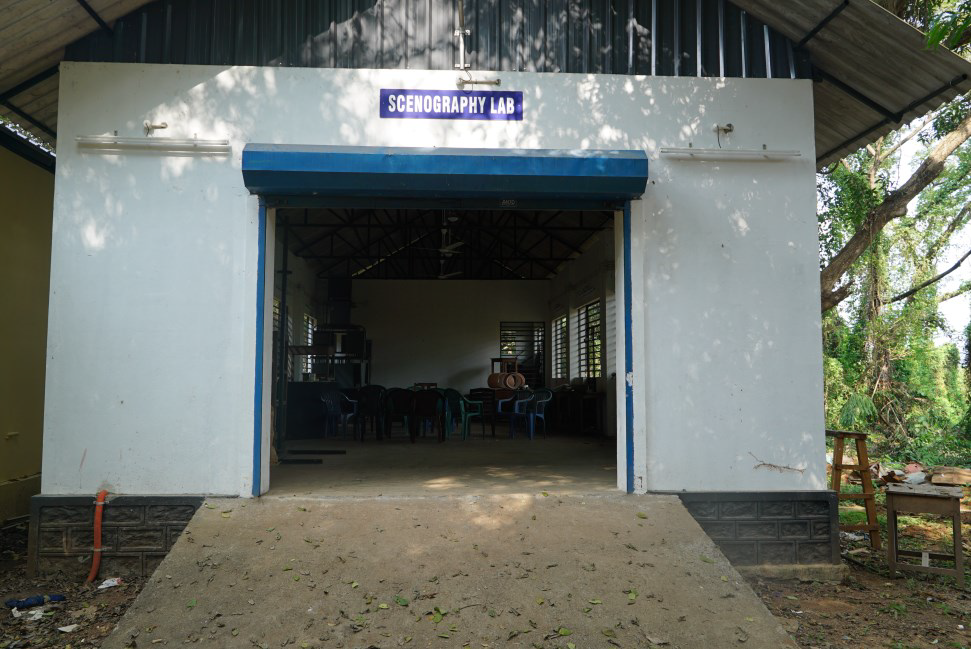
Scenography

Scenography Lab

Music

Music Department

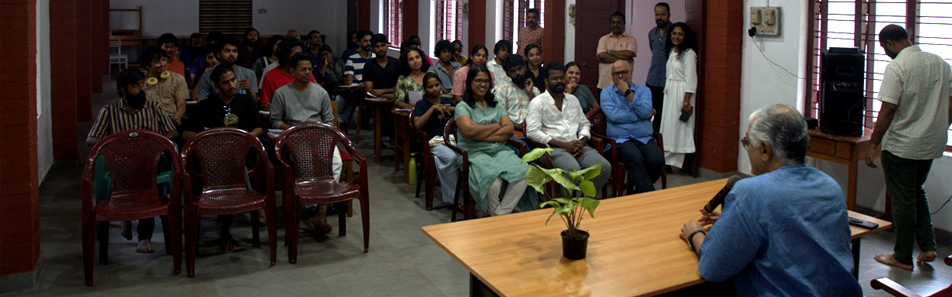
Seminar Hall

Seminar Hall

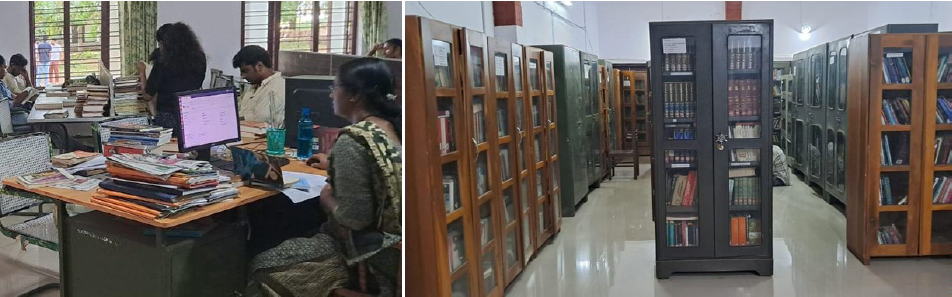
Library
Library
Location
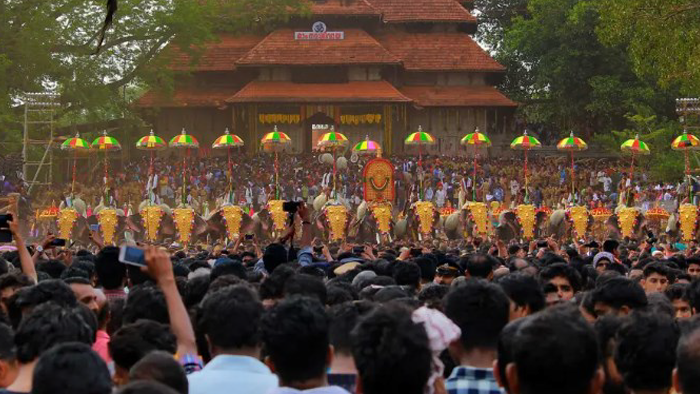
The school is situated in Thrissur, renowned as the cultural capital of Kerala, the southernmost state in India. Thrissur distinguishes itself in the cultural landscape of both the state and the nation, primarily owing to several prominent elements. These include the grand festival performance known as 'Pooram,' the exquisite architectural marvel of classical theatre represented by the 'Kootambalam,' and the presence of numerous other cultural institutions, such as the Fine Arts College, Thrissur Museum, Vadakkum Nathan Temple, Kerala Kalamandalam; the prestigious institution for traditional and classical performing arts, Kerala Sahitya Akademi, Kerala Sangeetha Nataka Akademi, Kerala Lalithakala Akademi, and more. This vibrant cultural milieu renders Thrissur a genuine haven for both practitioners and enthusiasts of the arts.
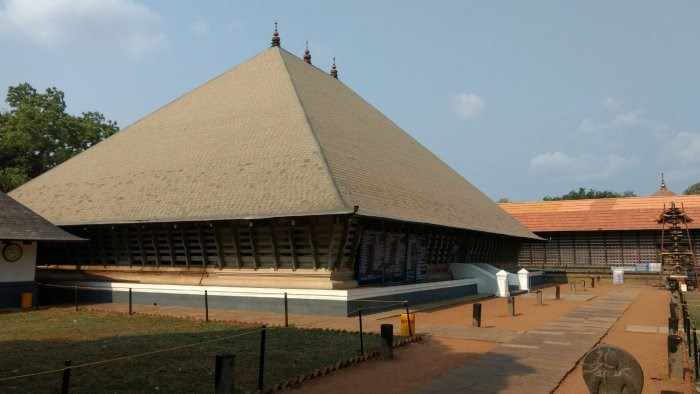
Koothambalam
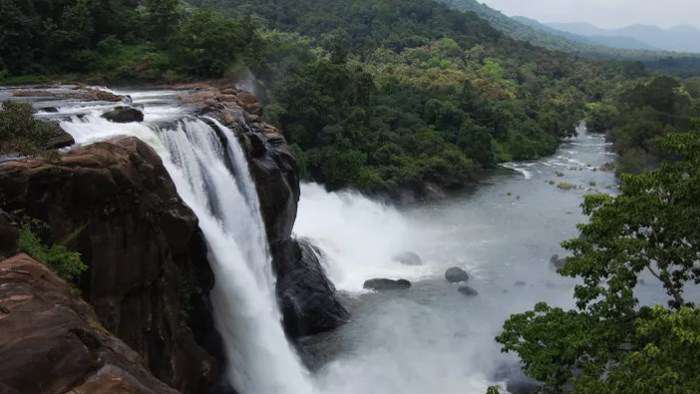
Athirapally Water Falls
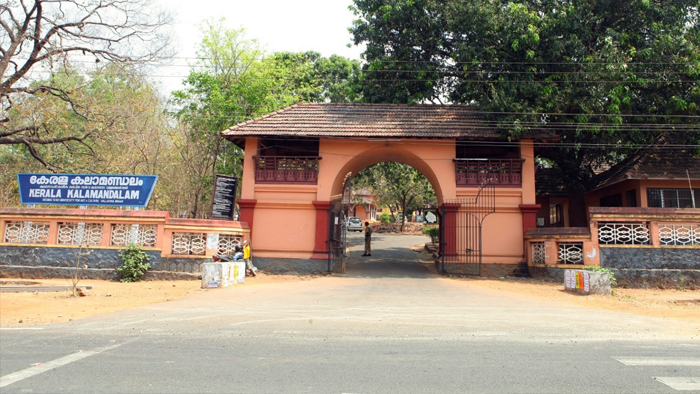
Kerala Kalamandalam
Thrissur Pooram